

Each year, SPARC hosts an immersive workshop focused on a specific topic for experts from around the world to dive into. These workshops provide deep discussions, discovery, networking and more. Please find a list of future topics below, as well as links to information and videos from our previous workshops.
SPARC Workshop 2026
The Critical Challenges of GeoAI
February 5-6, 2026 | ASU Tempe Campus | Memorial Union, La Paz 242
Calling all GeoAI researchers, critical thinkers, skeptical GIScientists, geographers, and educators! GeoAI has grown rapidly and sparked wide excitement, yet its limits and blind spots remain underexplored. To address this, the Spatial Analysis Research Center (SPARC) at ASU invites contributions to a workshop on the “Critical Challenges of GeoAI,” aimed at fostering open and constructive dialogue on the current limitations of GeoAI and the pressing challenges that remain unsolved.
Together, we’ll ask: What has GeoAI not yet delivered? Will GeoAI supplant traditional spatial analysis methods (e.g., spatial statistics and spatial optimization)? Is science built on foundation models (e.g., large language models and vision models) true science? What role can GeoAI play in advancing discovery in the spatial sciences and enhancing real-world decision-making? How can foundational geographic theory and practice contribute to the effective and ethical deployment of GeoAI? What unique role should geographers play in the AI revolution? Does AI threaten to devalue the work and expertise of geographers? Our discussion will cover the broader implications of both generative and deterministic AI in geospatial research and education.
We welcome comments that offer critical perspectives, share lessons learned, identify gaps, or outline new directions for the future of GeoAI. Submissions may highlight methodological shortcomings, overlooked theoretical foundations, model misuse and uncertainty, or broader implications related to ethics and trust in geospatial technologies.
Timeline
- October 24 - Call for participation released
- November 30 - Applications due
- December 7 - Participant selection & invitations sent
Travel
To help ensure broad participation, need-based travel funds covering airfare and lodging are available.
To Apply
Applications closed on November 30, 2025. For any questions about the workshop, please contact [email protected].
Organizing Committee
Wenwen Li, Patricia Solís, Heather Baier, Dylan Connor, Daoqin Tong, Andrew Trgovac
Spatial Analysis Research Center, Arizona State University
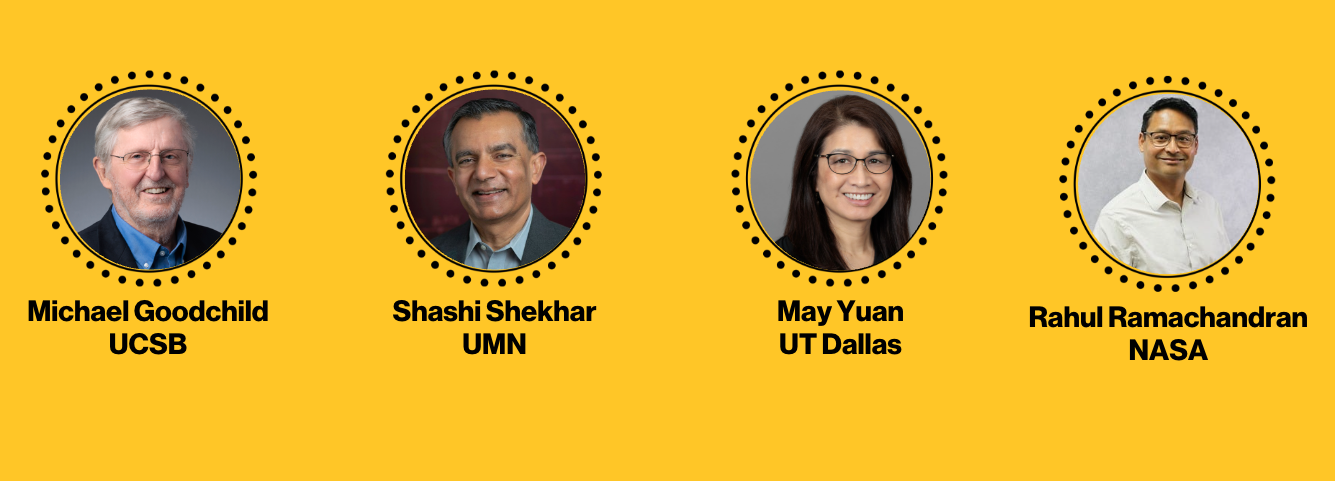
SPARC Workshop 2026 Keynote Speakers
Past Workshops
Held Feb. 5–6, 2026, the Spatial Analysis Research Center at Arizona State University hosted the Critical Challenges of GeoAI Workshop bringing together researchers, GIScientists, geographers and educators to explore the present and future of GeoAI. Learn more about this workshop.
A digital twin can be defined as "A virtual representation of the real world, including physical objects, processes, relationships, and behaviors" (Esri). This workshop goes into greater detail pertaining to this definition and so much more. Learn more about this workshop.
As part of its annual workshop series, the Spatial Analysis Research Center (SPARC) at Arizona State University organized a webinar entitled “Does GeoAI Promise an Ethical Future for Spatial Analytics?” The webinar was co-chaired by Michael Goodchild, Stewart Fotheringham, and Wenwen Li and it was the last in a series organized under the GeoEthics project, a collaboration between the American Association of Geographers and the University of California, Santa Barbara, with sponsorship from Esri. The webinar, held on February 8, 2022, featured an expert-led discussion of ethical GeoAI challenges and opportunities at the frontier of geographic research. Learn more about this workshop.
As part of this workshop series, in February 2021, SPARC presented a webinar on Ethical Spatial Analytics. This webinar was an inaugural webinar in a broader, multi-year initiative on ethics in geographic research being jointly organized by The American Association of Geographers, Esri, the University of California, Santa Barbara, and SPARC. Presentation ranged on the ethical implications of topics ranging from citizen science projects to remote sensing to GeoAI. Learn more about this workshop.
Spatial Scale is one of a small number of quintessential geographic topics that defines geography as a discipline. We talk about the scale of a map with expressions such as a ‘small scale’ or ‘large scale’ study. We refer to the scale of a study area, implying its spatial extent. We talk about some descriptors being scale-invariant (fractal dimension) while others are seriously affected by the extent to which data are spatially aggregated (modifiable areal unit problem). When focusing on the processes underlying spatial patterns, we frequently describe some processes as operating on a local, regional or global scale. Although we frequently refer to scale, what exactly do we mean by this term and how can we measure the spatial scale at which different processes operate? Learn more about this workshop.
Replicability and reproducibility (R&R) have always been core requirements of scientific research. Recently, cases of failure to replicate previously published findings have received widespread public attention. As research grows more complex and increasingly reliant on data and software, concerns about replicability will grow rather than diminish. For example, different software packages may produce different results even when the same technique of spatial analysis is applied to the same data or analysis results cannot be reproduced by the same software due to the lack of proper metadata or provenance documenting the spatial processing and parameters used. Geospatial researchers may need to be especially concerned about replicability, such as when results from one geographic area fail to be replicated in other geographic areas. Learn more about this workshop.